
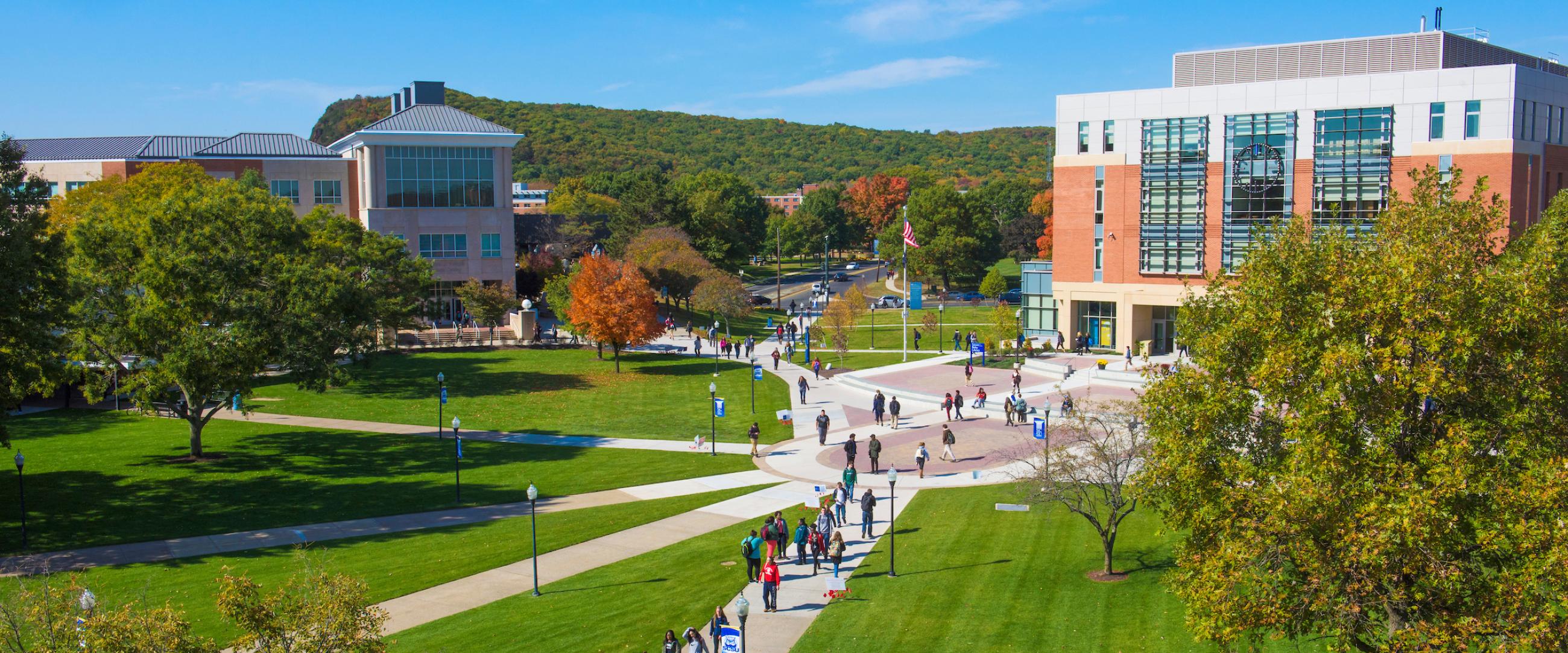
The Doctor of Education (EdD) in Nursing Education prepares nurse educators to become innovative leaders in academic and clinical education settings. As nursing education becomes increasingly global, the program welcomes students from around the world who are interested in advancing their expertise in teaching, curriculum development, and educational leadership. Coursework explores evidence-based teaching strategies, student evaluation, educational technology, and reflective teaching practices that are relevant across diverse cultural and healthcare contexts. International students have the opportunity to participate in a summer residency in New Haven, Connecticut, where they engage with faculty and BSN students while completing a supervised teaching practicum. This immersive experience provides hands-on teaching experience in U.S. nursing education while fostering international collaboration and exchange among nurse educators.
The Doctorate in Education (Ed.D.) in Nursing Education, collaboratively developed by faculty at Southern Connecticut State University (SCSU) and Western Connecticut State University (WCSU), is the only program of its kind in Connecticut and among the few nationwide. Building on the Connecticut State University System’s long-standing tradition of excellence in nursing and educator preparation, this innovative program offers nurses with clinical expertise and a master’s degree in nursing the knowledge and skills needed to become effective faculty members, advance the science of nursing education, and transform the education of future nurses.
To meet the needs of busy professionals, the program is delivered entirely online using synchronous and asynchronous learning modalities. Students will complete one on-ground Teaching Practicum in their geographic area.
Program Outcomes
The overall purpose of this program is to prepare individuals for the faculty role in nursing education. At the end of the program, degree candidates will be able to:
- Synthesize concepts and theories from nursing, higher education, and related disciplines as a foundation for enacting the nurse educator role.
- Demonstrate expertise in designing, implementing, evaluating, and improving nursing education to reflect trends in higher education, healthcare, and nursing practice.
- Use knowledge of ethical, social, global, cultural, political, and economic issues affecting nursing education to provide effective leadership.
- Contribute to the advancement of the science of nursing education through intellectual inquiry and creative scholarship.
- Provide professional leadership to affect change in nursing education through service to the profession.
- Function collaboratively in the faculty role within a community of scholars.
Careers
For over 50 years, Southern’s program has prepared graduates to incorporate professional standards to provide safe, evidence-based, and compassionate care of the highest quality to diverse populations. Graduates from all of the nursing programs are readily recruited by employers. According to the Bureau of Labor Statistics, employment of registered nurses is projected to grow 16 percent through 2024, much faster than the average for all occupations.
Nurses with Graduate Degrees Earn More
According to the Bureau of Labor Statistics (BLS), the median annual wage for registered nurses in 2021 was $75,330. With a master's degree or higher, you can expect to earn significantly more – with median salaries ranging from $100,000 to $120,000+.
In addition to higher salaries, nurses with graduate degrees may have access to more advanced positions and opportunities for leadership and management roles. They may also be eligible for higher pay grades and more benefits such as tuition reimbursement, retirement plans, and healthcare coverage.
Typical Job Titles
- Nursing Education Program Director
- Nursing Professor
- Nurse Researcher
- Nurse Administrator
General Information
Prospective students will apply to either SCSU or WCSU and receive their degree from the institution where they are matriculated. Admission policies to the program will be consistent with existing criteria for admitting doctoral students at SCSU and WCSU. A new cohort will begin every fall semester. Applications are now open for Fall 2025 and are on a rolling admission cycle. Applicants will be responsible for ensuring that all required documents are received.
The next application cycle is for the Fall 2025 entrance. Applications are accepted on a rolling basis.
Specific requirements are as follows:
- Complete the Graduate Application for the Ed.D. in Nursing Education program
- Master's degree in nursing, with an overall GPA of at least 3.0, from a regionally-accredited institution
- Official transcripts of all prior undergraduate and graduate level coursework
- Three (3) current references from individuals who can speak to the applicant's academic ability, professional achievements, and potential for success in doctoral studies
- Current RN license
- Current resume/CV highlighting professional experience, scholarship, and service activities
- Personal statement describing the following:
- Reasons for seeking admission to the Ed.D. program
- Professional goals
- Research interests
- Potential contributions to the field of nursing education
- For international students, a score of at least 550 (paper), 213 (computer), or 80 (internet) on the TOEFL exam
All application materials, with the exception of transcripts and letters of recommendation, may be uploaded after submitting your application. Letters of recommendation are uploaded directly by your recommenders. Official transcripts can be sent to GradDocs@southernct.edu. Official paper transcripts must be sent to Southern's Processing Center. Information can be found on the Graduate Application website.
The overall goal of the admissions committee is to admit individuals who, in the professional opinion of the faculty, demonstrate the greatest potential for making significant contributions to the field of nursing education through their teaching, scholarly, and service activities.
Program Components
The prposed 51-credit program consists of five major components, listed below in the required sequence:
Foundations of Teaching in Higher Education (each course is 3 credits; 9 credits total)
- NUR 800 Ethical/Legal, Political and Social Issues Affecting Higher Education
- NUR 801 Theories of Teaching and Learning in Adult and Higher Education
- NUR 802 Methods of Teaching and Evaluation
Specialization in Nursing Education (each course is 3 credits; 9 credits total)
- NUR 803 Curriculum Development, Implementation, and Evaluation in Nursing
- NUR 804 Nursing Faculty Role in Higher Education
- NUR 805 Classroom, Clinical Teaching and Evaluation in Nursing Education
Leadership in Nursing Education (each course is 3 credits; 9 credits total)
- NUR 806 Leadership Theories and Concepts
- NUR 807 Leadership in Nursing Education
- NUR 808 Doctoral Synthesis
Science of Nursing Education Research (each course is 3 credits; 12 credits total)
- NUR 809 State of Science of Nursing Education Research
- NUR 810 Quantitative Methods in Nursing Education Research
- NUR 811 Qualitative Method in Nursing Education Research
- NUR 812 Statistical Analysis in Educational Research
Dissertation Phase (each course is 3 credits; 9-12 credits total)
- NUR 813 Dissertation Seminar
- NUR 814 Dissertation Advisement I
- NUR 815 Dissertation Advisement II
- NUR 816 Dissertation Advisement III
- NUR 817 Ongoing Dissertation Advisement
See: Plan of Study (PDF)
The purpose of the NFLP is to increase the number of qualified nursing faculty. The program offers partial loan forgiveness for borrowers who graduate and serve as full-time nursing faculty for the prescribed period of time. The Ed.D. The Nursing Education program has been fortunate to receive funding through the NFLP for six years through HRSA, although there is no guarantee that funding will be available in any given year. The NFLP loan can help with the cost of tuition, fees, books, and laboratory expenses. The NFLP loan cannot be used for room, board, personal, transportation, or living expenses. There is a limited amount of NFLP available. The NFLP is a non-need-based loan program. The loan cannot exceed $35,500 per academic year, and it is not to exceed 5 years of support. Please visit the Graduate loan page to learn more about the NFLP.
Global Community of Nurse Educators
Join a doctoral program that welcomes nurse educators from around the world. Students learn alongside colleagues with diverse professional and cultural perspectives, creating a collaborative environment that enriches discussions about nursing education across different healthcare systems.
Evidence-Based Teaching and Curriculum Design
Develop advanced expertise in teaching strategies, curriculum development, and student evaluation grounded in contemporary nursing education scholarship. The program prepares graduates to design innovative learning experiences and lead educational programs in a variety of global contexts.
Summer Teaching Residency in New Haven, Connecticut
International students have the opportunity to spend a summer on campus working with faculty and BSN students while completing a supervised teaching practicum. This immersive experience provides hands-on exposure to teaching in a U.S. nursing education setting while building mentorship relationships with experienced nurse educators.
Focus on Educational Leadership
The EdD prepares graduates for leadership roles in nursing education, including faculty positions, program leadership, and curriculum development. Students develop skills in academic leadership, faculty development, and program evaluation that can be applied across international educational settings.
Integration of Educational Technology
Students explore innovative teaching technologies—including simulation, online learning, and digital education tools—to support effective teaching and learning in both local and global nursing education environments.
Flexible Learning for Working Professionals
The program is designed for practicing nurse educators and healthcare professionals, allowing students to continue their professional roles while completing doctoral coursework and scholarship.
Professional Networking and Collaboration
Students build connections with faculty, doctoral peers, and academic leaders that support long-term collaboration in nursing education, research, and program development worldwide.
Accreditation
Fully accredited by the Commission on Collegiate Nursing Education (CCNE). This program has been licensed by the Connecticut Board of Regents and approved by NECHE.
The Ed.D. program objectives are consistent with SCSU's and WCSU's mission to educate students within a diverse, caring, and scholarly learning community dedicated to excellence. Learn more about the Dissertations Defended.
School / College
College of Health & Human Services
Department
Nursing